

Why is it so hard to ask for help?
Why do we find it so difficult to ask for help, even when we're struggling? Explore how independence, pride and our beliefs about ourselves can make accepting support uncomfortable.
When Did Needing Help Become a Bad Thing?
We often look at people around us and admire them for how independent they are. We think of them as strong and reliable - able to manage alone. All good qualities, but sometimes I wonder if we at times can just be too independent? Over the years we might develop a belief that being capable and independent means we don’t have to rely on other people, or them letting us down. We might think “they have enough going on, without having to deal with me too”. We can also have the view that asking for help makes us seem week or incompetent.
It could be that when we were growing up we were told things like “get on with it” or “you’ve got to learn to stand on your own two feet. These sorts of messages can become rules that we live by without really questioning them.
But….when did being independent start meaning we had to do it all alone?
Being Able to Cope Doesn't Mean We Have To
Picture this - you’ve just been to Tesco for shopping and carrying a few heavy bags. Someone offers to carry a couple for you - but you refuse. Not because you don’t need the help to carry them, but just because you feel you should be able to manage yourself.
You get back to the car - exhausted and with a sore back, but was that struggle really necessary?
We can be exactly the same with emotional difficulties. We might feel stressed at work, have money problems, relationship issues and lots on our minds. We can tell ourselves that we just need to get on with it, that we should be able to cope. We often don’t seek out the help that might really benefit us because we believe we should be capable enough to do it alone.
At times, we can make things so much harder for ourselves in the long run by not asking for help or accepting help.
What Does Asking for Help Mean to Us?
We might feel that asking for help is an inconvenience. We might think it is like admitting defeat. It might look like incompetence. It might make people think of me in a different light. Maybe we have always been the one everyone else turns to for help, and asking for help just feels wrong.
My wife and I have talked a lot about the concept of just taking people at their word. It can be hard to learn to do this, but very rewarding to not have to ask the questions about whether they mean what they are saying, if they are happy or not.
But it's worth asking ourselves whether these are facts or simply conclusions we've drawn. If a friend came to us and said they were struggling, would we automatically think they were weak or incapable? Would we lose respect for them because they needed some support? We wouldn’t, so why do we apply different rules to ourselves?
Why Is Accepting Help Sometimes Even Harder?
There's another interesting side to this. Sometimes we don't even need to ask. Someone offers to help, and we still turn them down. We might say, “I don’t want to put you to any bother,” even when the person has offered. We might insist that we don’t need the help and that everything is fine. We might feel that by accepting help offered to us we are then indebted, or have even lost a bit of control.
For some of us, giving other people help feels much easier than receiving it. We're happy to support other people in whatever way we can, but uncomfortable allowing them to do the same for us. Maybe we have just become so used to being the person who manages everything that we don’t actually know how to let others take some of the weight off our shoulders.
Maybe, by repeatedly refusing help - we don't give the people who care about us the opportunity to support us in the way we'd happily support them.
What Would Happen If We Said Yes?
Maybe the next time someone offers to help us, we could take a breath and pause before automatically refusing help. Instead of saying “no I’m fine” - why not ask ourselves why we are so reluctant to accept the help. What feelings do we have about saying yes.
We can start with something small. Maybe ask a colleague to help you with a piece of work or ask a family member to assist with something in the house.
It might feel unfamiliar at first and maybe even uncomfortable - especially if we’ve spent years believing doing everything ourselves is best. But feeling uncomfortable doesn’t mean we are doing anything wrong, it just means we are trying something new that we aren’t used to, and that is ok!
Strength Doesn't Have to Mean Doing Everything Alone
Being independent is great! But so is recognising when we might need help. We never question other people who ask us for support - and usually we are happy they have trusted us enough to ask.
Maybe strength isn't always about how much we can carry without anyone noticing.
Maybe sometimes it's about recognising when we don't need to carry it all ourselves.
So how about the next time someone asks you if you need a hand give real thought to whether “no I’m fine” really is the best response. Think about accepting the help offered - and see how it makes you feel.
Are You Spending Your Energy on Things You Can't Control?
How much time do we spend worrying about things we can't change? Explore the Circle of Control, how it relates to CBT and a simple exercise to help focus your energy where it matters.
Have you ever spent half an hour worrying about something you can't actually do anything about?
Replaying a conversation that's already happened, wondering what someone thinks of you or worrying about whether you'll get the job
We can spend so muchf time and energy trying to control things that were never entirely ours to control in the first place.
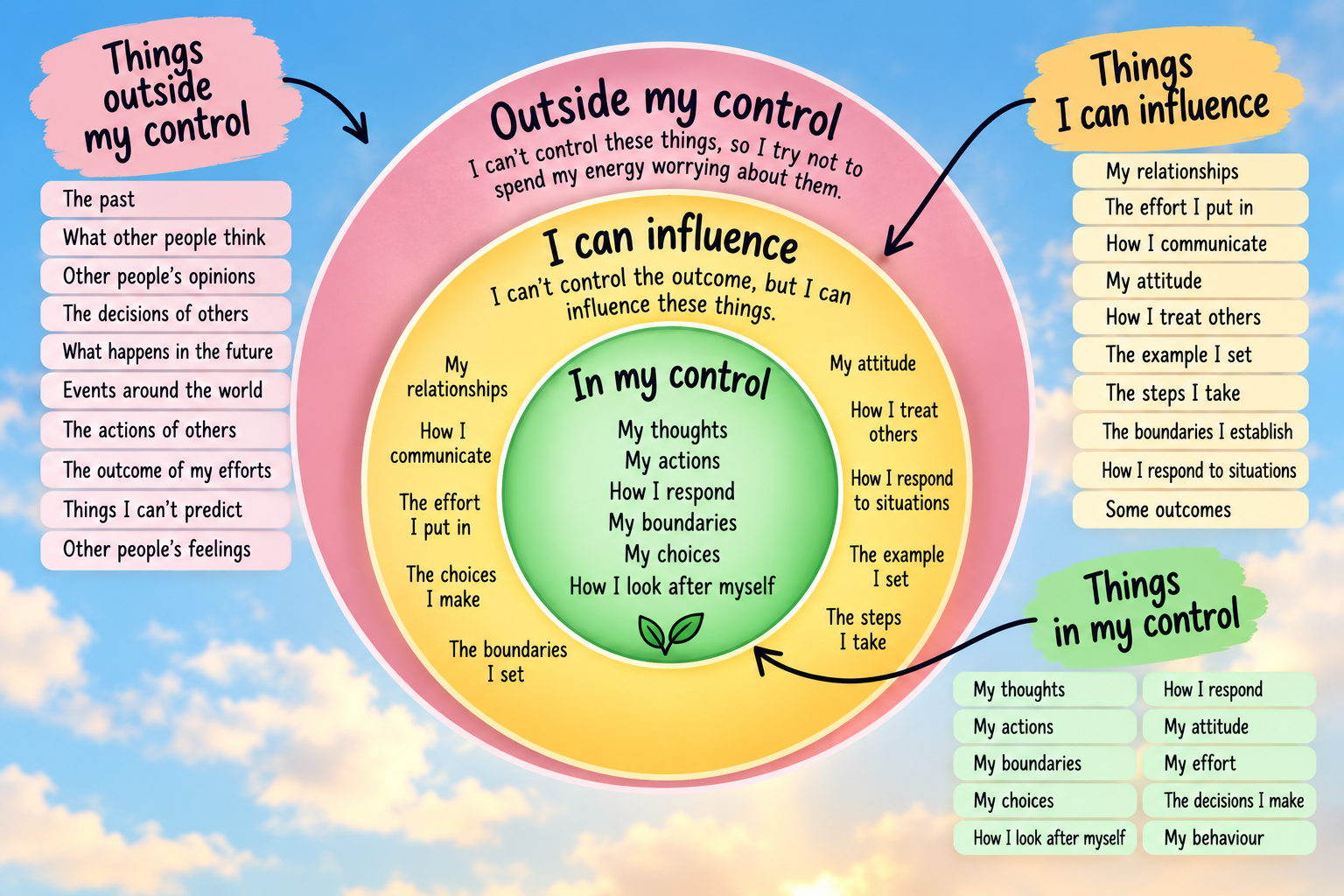
The Circle of Control
One useful idea often explored in CBT is the Circle of Control.
It's a simple way of looking at where we're directing our attention and energy.
Imagine dividing the things we're worrying about into three categories:
Things we can control
Things we can influence, but not control
Things outside our control
What Can We Actually Control?
Let's imagine you've applied for a job you really want. You've spent time preparing, researching the company and getting ready for the interview.
Now you're waiting to hear back. You find yourself checking your emails constantly.
What if I didn't answer that question properly?
What if they've already chosen someone else?
What if I don't get it?
You replay the interview, searching for things you could have said differently.
But here's the reality.
You can control how you prepare, whether you attend the interview and how you choose to respond to questions.
You can influence the outcome by presenting yourself well.
But you cannot control the final decision, and no amount of worrying afterwards will change what you said in that interview.
That's where the Circle of Control becomes useful., as it encourages us to recognise the difference between taking responsibility for our actions and trying to take responsibility for an outcome that isn't entirely ours.
What About the Things We Can Influence?
This is where the Circle of Control becomes a little more interesting, as not everything fits neatly into can control or can't control.
Some things sit somewhere in between.
Think about a relationship. You cannot control how another person feels, what they think or how they behave, but you can influence the relationship through how you communicate, the effort you make and the boundaries you establish.
You can apologise when you've made a mistake, you can explain how something has affected you, you can listen actively.
But you cannot guarantee the other person's response. Recognising this difference can help us stop carrying responsibility for things that don't belong entirely to us.
Why Do We Keep Worrying About Things We Can't Change?
Sometimes worrying gives us a sense that we're doing something useful. If we think about a problem long enough, perhaps we'll find a way to prevent something bad from happening.
We might believe that worrying means we're being responsible or prepared. But there's a difference between thinking about a problem to find a solution and going over the same uncertainty without getting anywhere.
One helps us take action - The other can leave us feeling exhausted.
In CBT, we can explore the thoughts and beliefs that keep these patterns going.
For example:
If I worry enough, I'll be prepared for anything.
If someone is upset with me, I have to make it right.
If something goes wrong, it means I didn't try hard enough.
These beliefs can place an enormous amount of pressure on us.
And they aren't always accurate.
Letting Go Isn't the Same as Giving Up
Sometimes the idea of accepting what we can't control sounds like we're being asked to stop caring, but that's not what it means at all.
We can care deeply about an outcome without being able to guarantee it.
We can love someone without being responsible for every decision they make.
We can work hard without knowing whether we'll succeed.
We can prepare for the future without being able to predict it.
Acceptance isn't always about liking a situation. Sometimes it's about recognising the limits of what we can change.
And when we recognise those limits, we can make better choices about where to put our time and effort.
One Question Worth Asking
The next time something is occupying your thoughts, ask yourself:
"Is there something I can actually do about this, or am I trying to control something that isn't mine to control?"
If there's something you can do, perhaps that's where your energy belongs.
And if there isn't?
Maybe the challenge isn't to think about it harder.
Maybe it's learning to live with not having all the answers.
Because we have a limited amount of time and energy. How much of yours is being spent on things you can't change?
The Poisonous Parrot: That Little Voice That Never Seems to Shut Up
We all have an inner voice, but what happens when it constantly criticises, doubts and discourages us? Meet the Poisonous Parrot and discover how CBT can help us respond differently to negative thoughts.
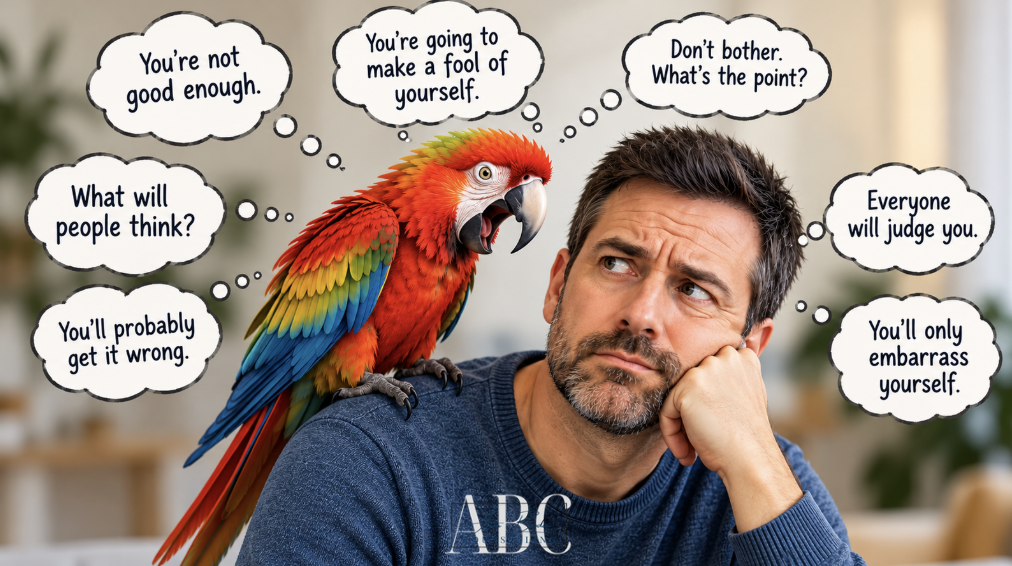
Imagine having a parrot sitting on your shoulder.
Not a colourful, friendly parrot that whistles a tune or says hello.
This one's a bit different, because it has an opinion on absolutely everything you do.
And unfortunately, it's rarely anything encouraging.
“You're going to make a fool of yourself.”
“You're not good enough.”
“What will people think?”
“You'll probably get it wrong.”
“Don't bother. What's the point?”
Sound familiar?
Welcome to the Poisonous Parrot.
We all have an inner voice
Most of us have an ongoing conversation with ourselves throughout the day.
We make decisions, question things, reflect on experiences and sometimes criticise ourselves.
But for some of us, that inner voice can become particularly negative.
It comments on our appearance, our abilities, our relationships and even things we haven't done yet.
And the more often we hear those messages, the easier it can become to accept them as the truth.
But here's something worth remembering.
Just because we think something doesn't mean it's true.
The parrot loves an audience
Imagine you've written something you'd like to share on Facebook.
You're happy with it.
You're about to press Post.
Then the parrot starts.
“Carol won't like that.”
“John will think you're showing off.”
“What if nobody likes it?”
“What if someone makes a nasty comment?”
Suddenly, you're questioning something you felt perfectly comfortable with a few minutes earlier.
You might rewrite it, water it down or decide not to post it at all.
And the interesting thing?
Nobody has actually said anything.
The parrot has done all the talking.
Where does the parrot get its material?
Our inner voice doesn't develop in isolation.
Past experiences, criticism, embarrassment, expectations and beliefs about ourselves can all influence the things we tell ourselves.
Perhaps someone once told us we weren't good at something.
Maybe we made a mistake that stayed with us throughout or life
We might have spent years comparing ourselves with other people.
Over time, certain messages can become familiar.
“I'm not clever enough.”
“People won't like me.”
“I always get things wrong.”
And eventually, we might stop questioning them.
So - when the parrot says it - we believe it.
You don't have to argue with the parrot
We might think the answer is to get rid of every negative thought.
But trying to force thoughts away can sometimes make us even more aware of them.
Instead, we can learn to recognise what's happening.
“There's that thought again.”
“That's my fear of being judged talking.”
“I'm predicting something that hasn't happened.”
The thought might still be there.
But we don't have to give it the same power in our minds.
A thought is not an instruction.
What would happen if we stopped obeying it?
Think about how many things we might avoid because of what our inner voice tells us.
Applying for a job.
Speaking up in a meeting.
Trying a new hobby.
Meeting new people.
Sharing an opinion.
Making a change.
The parrot might insist that something will go wrong.
But what if we just went ahead and did it anyway?
What if we allowed ourselves to feel uncertain without letting that uncertainty make the decision?
What if we discovered that we could cope even when things didn't go perfectly?
That's where change can begin.
Learning to recognise the voice
CBT can help us identify unhelpful thinking patterns, examine the evidence behind our thoughts and develop different ways of responding.
Instead of automatically accepting “I'm going to embarrass myself”, we can ask:
“What evidence do I actually have for that?”
Instead of believing “Everyone will judge me”, we can consider whether we're predicting other people's thoughts without really knowing them.
And instead of avoiding something because we're afraid, we can begin taking small and manageable steps towards the things that matter to us.
The aim isn't to become someone who never doubts themselves.
It's to stop allowing every doubtful thought to decide what happens next.
Let the parrot squawk
The Poisonous Parrot might never disappear completely.
It may still have something to say when we try something new, take a risk or step outside our comfort zone.
But we can learn to recognise its familiar voice and question what it is telling us. We can choose to listen or not.
So the next time that little voice tells you that you're not good enough, that people will laugh or that you shouldn't even try, remember:
The parrot can squawk all it likes.
You don't have to let it run your life.
When Did Being Busy Become Something to Be Proud Of?
Being busy has almost become a badge of honour. But why can slowing down leave us feeling guilty? A look at productivity, rest and the pressure to always be doing something.
“How are you?”
“Busy.”
For many of us, being busy has almost become a badge of honour. I can think of a couple of people throughout the years - where I knew they were going to say they were “so busy” even before they said it.
A full diary. A long to-do list. Always having somewhere to be or something that needs done.
And when we finally get a bit of time with nothing planned?
Instead of enjoying it, we can feel strangely guilty.
“I should be doing something”.
When did doing nothing become a problem?
There’s nothing wrong with being busy. Work, family, relationships and everyday responsibilities all take up our time.
The problem comes when we begin to measure our value and worth by how busy we are.
A busy day feels successful.
A quiet day feels like it is a wasted day.
We might sit down to relax and immediately start thinking about the emails, the garden or the dozen other things we could be doing.
Our body has stopped, but unfortunately our mind hasn’t
The never ending to-do list
One difficulty with waiting until everything is finished before allowing ourselves to relax is that everything is rarely finished.
There will nearly always be another job, another email.
Another thing we could tidy, organise or sort out.
If rest has to be earned by completing everything first, we might just never feel we've quite “earned it”.
Why can slowing down feel uncomfortable?
When we're used to constantly being on the go, stopping can feel unfamiliar to us.
Sometimes being busy also gives us less opportunity to notice what's going on underneath the surface.
When things become quiet, thoughts or feelings we've been distracted from can suddenly appear out of nowhere.
So we fill the space again - just to distract from the feelings…..Another job. Another task. Another scroll through the phone.
Not necessarily because any of it needs done right now — but because being occupied feels easier than being still.
Rest isn't the opposite of being productive
Rest doesn't have to mean lying on a beach on holiday (although I did enjoy this recently)
It might be half an hour reading a book.
Going for a walk without turning it into an exercise routine
Having a coffee without feeling you should be doing something else.
And perhaps most importantly, doing it without mentally putting yourself on trial for it.
CBT can help us notice some of the rules we've developed for ourselves:
I should always be doing something.
I can't relax until everything's finished.
I'm being lazy.
What must people think of me when I look like I am sitting doing nothing?
And then ask whether those rules are actually helping us.
Being busy isn't necessarily a sign that we're doing life well.
And having nothing to do for a while isn't something we need to fix.
Sometimes a gap in the diary can simply be...
a gap in the diary.

Why do we remember criticism for years - but forget compliments - if we even accept them?
Why can one critical comment stay with us for years while compliments are quickly forgotten? Explore why we can hold onto criticism, dismiss the positive and how a more balanced perspective can help.
Someone tells us we've done a great job. What is our automatic response? Do we smile and say thanks then just continue with our day? Sometimes I wonder if it is just a Scottish stereotype that we can’t accept praise, or if it is just how we all are as humans.
Someone makes only one slightly critical comment. Three years later, we can still remember exactly what they said, where we were and how it made us feel.
Why does criticism seem to stick in our minds - yet compliments somehow disappear instantly?
Our minds don't treat everything equally
You’d think that if we get ten positive comments and one negative - they would balance themselves out…..
But that's not always how it is.
Our attention can be naturally drawn towards things that seem threatening, uncomfortable or potentially important.
A compliment might feel nice.
Criticism can feel like something we need to do something about and our mind holds onto it.
What we already believe matters
Imagine someone already doubts their ability at work.
Their boss says:
“You've done a really good job with this.”
They might think:
They're just being nice.
Anyone could have done it.
It wasn't that hard a job.
But if the same manager later says:
“There's a mistake here.”
Suddenly:
I knew I wasn't good enough.
Notice what happened.
The compliment was questioned.
The criticism was accepted as evidence.
We can become very good at dismissing the positive
It doesn't always look obvious.
We might say:
I was just lucky.
They had to say that.
It was nothing.
Anyone would have done the same.
Without realising it, we're explaining away information that doesn't fit with how we already see ourselves.
Yet when something negative fits that belief, we may accept it without questioning it at all.
Try treating both as evidence
The aim isn't to convince ourselves we're brilliant at everything. Nobody is!
But ignoring positive feedback isn’t good.
If someone criticises us, we can ask ourselves:
Is this fair? Is there something useful I can take from it?
But when someone compliments us, perhaps we can ask something too:
What if they're right?
Rather than immediately explaining the compliment away, try allowing it to count.
A more balanced picture
CBT isn't about replacing every negative thought with a positive one.
It's about looking at the fuller picture.
That means recognising mistakes and areas we'd like to change without allowing them to become the entire story of who we are.
And it means allowing the positive evidence to have a place too.
So next time someone gives you a genuine compliment, notice what your mind does with it.
If your immediate response is “Yeah, but…” why not try taking a pause and stopping before the “but”.
You don't have to argue with every nice thing someone says about you.
Sometimes you can simply say - thank you. Take it on board and accept the encouragement you have been given!
Why Do We Put Things Off When We Know They’ll Make Us Feel Better?
Why do we put things off even when we know we’ll feel better afterwards? Discover how avoidance brings short-term relief, why that can keep us stuck and how taking one small step can help.
We’ve probably all done it.
There’s something we know needs done.
Make the phone call. Reply to the email. Go for the walk. Sort the paperwork. Have the conversation. Make the appointment.
We know we’ll probably feel better once it’s dealt with.
Yet somehow… we keep putting it off.
It’s not always laziness
Procrastination is often described as poor motivation or laziness.
But sometimes we’re not avoiding the task itself.
We’re avoiding how we expect the task to make us feel.
A phone call might bring anxiety.
Opening a letter might bring worry.
Starting something new might bring the possibility of failure.
Having a difficult conversation might bring discomfort.
So we put it off.
And for a little while, that works.
Avoidance can feel good
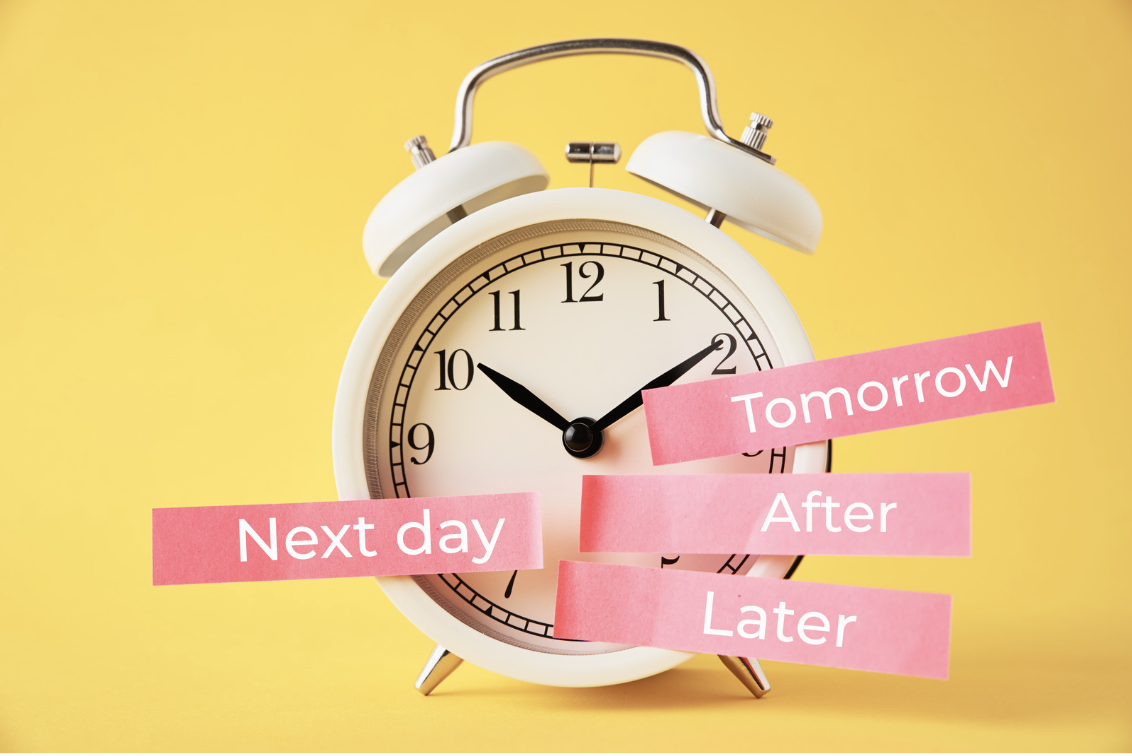
Imagine there’s a phone call you’ve been dreading all morning.
You decide:
I’ll do it tomorrow.
Almost immediately, you feel some relief.
The problem hasn’t disappeared - but the uncomfortable feeling has reduced.
Our brain notices that.
I avoided it and I felt better.
That short-term relief can make us more likely to avoid the same thing again.
Before we know it, something that might have taken ten minutes has occupied our thoughts for three days.
Waiting until we “feel like it”
We can also fall into the trap of waiting for motivation.
I’ll do it when I feel more confident.
I’ll start when I have more energy.
I’ll deal with it when I’m less anxious.
But sometimes the feeling we're waiting for comes after we take action, not before it.
Confidence can grow because we did something while feeling nervous.
Motivation can appear once we've started.
Relief can come because we finally dealt with what we'd been avoiding.
Make the first step smaller
When something feels overwhelming, we often picture the entire task.
Instead, ask:
What is the smallest useful thing I could do next?
Not finish everything.
Just the next step.
Open the email.
Find the phone number.
Put your shoes on.
Write the first sentence.
Sometimes getting started is more important than feeling ready.
A different way of looking at it
CBT can help us understand the relationship between what we think, how we feel and what we do.
Avoidance isn't something to beat ourselves up about.
But recognising when short-term relief is creating a longer-term problem can give us the opportunity to respond differently.
We don't always have to wait until something feels comfortable before doing it.
Sometimes we do the uncomfortable thing first.
And the feeling catches up afterwards.

Help - I Just Can’t Stop Overthinking!
Overthinking can leave us stuck in a cycle of doubt and uncertainty. Discover why we overthink, what keeps the cycle going and how CBT can help us respond differently.
Most of us overthink from time to time.
We replay conversations, question decisions we've already made or try to predict what might happen next.
If we think about something for long enough, surely we'll eventually find the answer/
But often the opposite happens. The more we think, the less certain we become.
When thinking becomes overthinking
Thinking about a problem can be useful when it leads us towards a decision or an action.
Overthinking tends to keep us going around the same thoughts without getting anywhere.
We might find ourselves asking:
What if I've made the wrong decision?
Why did I say that?
What did they mean by that?
What if something goes wrong?
Should I have done something differently?
We may even replay the same situation repeatedly, hoping we'll eventually reach a conclusion that makes us feel certain.
The problem is that certainty doesn't always come.
Why do we keep doing it?
Overthinking is often an attempt to protect ourselves.
If we can predict every possible outcome, perhaps we can prevent something going wrong.
If we analyse a conversation enough, perhaps we can work out exactly what someone was thinking.
If we reconsider a decision one more time, perhaps we'll finally know we've made the right choice.
But there are some things we simply can't know for certain.
And continually searching for certainty can sometimes create even more doubt.
The difference between facts and conclusions
One useful CBT approach is learning to recognise the difference between what we actually know and the conclusions we've drawn.
For example:
Fact: Someone hasn't replied to my message.
Conclusion: I've upset them.
The conclusion might be true — but there could also be many other explanations.
When we're anxious or worried, our minds can sometimes treat an assumption as though it were a fact.
Simply noticing that difference can give us another way of looking at the situation.
Ask yourself: is this helping me solve something?
When you notice yourself going over the same thoughts again, try asking:
“Is there something useful I can do about this right now?”
If there is, taking a small practical action may be more helpful than continuing to think about it.
If there isn't, another hour of thinking may not provide the certainty you're looking for.
The aim isn't to stop thinking.
It's learning to notice when thinking has stopped being useful and has started keeping us stuck.
How CBT can help with overthinking
CBT can help us become more aware of the patterns between our thoughts, feelings and behaviours.
Rather than simply telling ourselves to “stop overthinking”, we can begin to understand what keeps the cycle going and develop more helpful ways of responding to uncertainty, worry and difficult thoughts.
Sometimes the goal isn't finding the perfect answer.
It's becoming more comfortable with the fact that we don't always need one.

What is CBT therapy and how can it help me?
CBT can help us understand the connection between our thoughts, feelings and behaviours. Find out how CBT works, what it can help with and what to expect from therapy.
Cognitive Behavioural Therapy, often shortened to CBT, is a form of talking therapy that looks at the connection between our thoughts, feelings and behaviours.
We can all find ourselves stuck in patterns that are difficult to change. We might know that worrying isn't helping, recognise that we're avoiding certain situations, or realise we're being overly critical of ourselves - but knowing this doesn't always make it easy to do something differently.
This is where CBT can help.
How does CBT work?
CBT is based on the idea that the way we think about a situation can influence how we feel and how we respond.
For example, two people can experience exactly the same situation but interpret it very differently. Those different thoughts can lead to different emotions and behaviours.
Sometimes our thoughts happen so quickly that we don't even realise how much they're affecting us.
CBT can help us slow things down, recognise these patterns and look at whether our thoughts and behaviours are helping us, or if they are keeping us stuck.
The aim isn't to just “think positively”.
It's about developing a more balanced understanding of what is happening and learning practical ways to respond differently.
What can CBT help with?
CBT can be helpful for a range of difficulties, including:
Anxiety and excessive worry
Stress and feeling overwhelmed
Panic attacks and panic disorder
Social anxiety
Phobias and fears
Low mood and depression
Low self-esteem and confidence
Overthinking and negative thinking
Avoidance and feeling stuck
Managing difficult thoughts and emotions
We don't necessarily need to have a diagnosis before considering therapy. Sometimes we simply just recognise that something isn't working for us and we'd like some help understanding it.
What happens during CBT therapy?
CBT is generally a very practical form of therapy.
Therapist and client will work together to understand what's happening, identify patterns and explore changes that may help.
This might involve looking at particular situations, the thoughts that arise, how they make us feel and what we tend to do in response.
Over time, we can begin to recognise patterns more easily and develop strategies that can be used outside the therapy session too.
CBT isn't about me as a therapist telling you what to think or what to do. It's about working together to understand the difficulties and finding approaches that are realistic and practical.
Can CBT therapy be done online / or is in-person better?
Yes. Online CBT therapy sessions are extremely popular, allowing people to access support from their own home.
For some people, online therapy can make fitting sessions around work, family or other commitments easier. It also means that your location doesn't have to be a barrier to accessing therapy.
I provide online CBT therapy for adults across the UK, alongside in-person sessions in Lanarkshire and the surrounding areas.
Is CBT right for me?
There's no single type of therapy that's right for everyone.
A useful starting point is simply having a conversation about what you're experiencing, what you'd like to change and what you're hoping to get from therapy.
You don't need to have everything figured out before getting in touch.
About Me
I'm Alan, a qualified counsellor and CBT therapist and a member of the governing body COSCA.
I work with adults experiencing difficulties including anxiety, panic, stress, low mood, low self-esteem, phobias, overthinking and avoidance.
My approach to CBT is practical and focused on helping people better understand what's happening for them and develop ways of moving forward.
I offer online CBT therapy across the UK, and in-person appointments available in Lanarkshire and the surrounding areas
Sessions last approximately 50–55 minutes and cost £50.
If you're considering CBT but aren't sure whether it's right for you, I offer a free 15-minute introductory call where we can briefly discuss what you're looking for and how I can help you move forward in your journey. - Get in touch

Rest - Relax - Reset
RESTING - RELAXING - RESETTING
I’ve just returned from holiday feeling rested, refreshed and reminded of how easy it is to forget to switch off at times.
Rest and relaxation give our minds and bodies a chance to slow down, step away from everyday pressures and reset.
It doesn’t have to mean going on holiday. Sometimes it’s just recognising when we’ve been running on empty and giving ourselves permission to stop for a while.
Taking a break isn’t completely stepping away from life, sometimes it helps us return to it with a clearer head ready to keep going with our journey.